
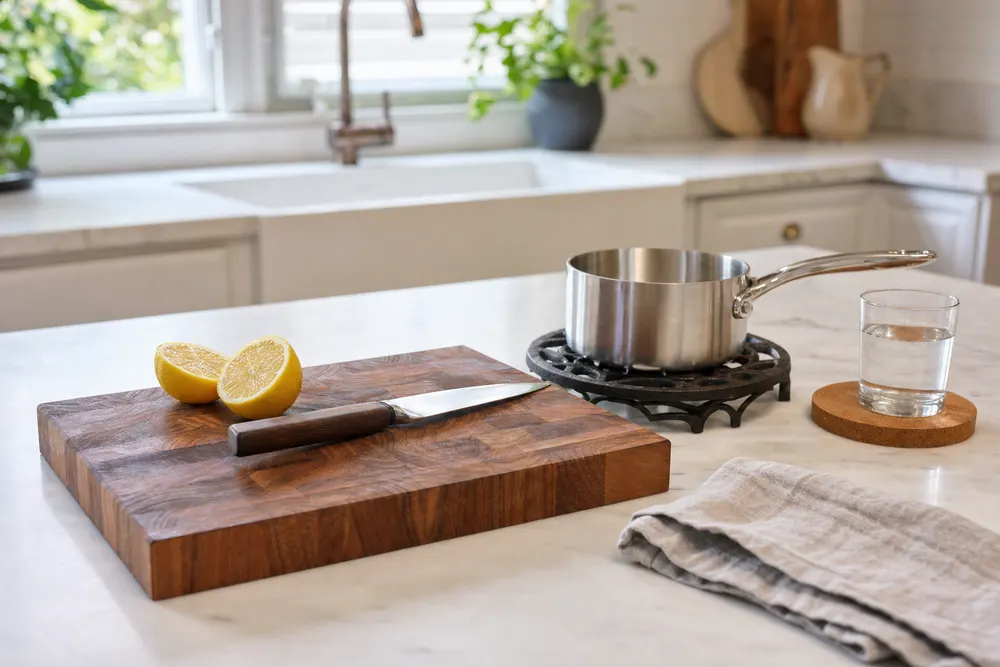
Search "kitchen benchtop protector" and you'll get five different products wearing the same name: chopping boards, heat mats, rolls of temporary film, bottles of sealer and permanent protection film. They do five different jobs, and the marketing rarely admits which job is which. Here's the honest version, including the options we don't sell.
Boards, trivets and mats
Keep them. Seriously. A chopping board is the correct place to meet a knife, and a trivet is the correct place to land a pan straight off the flame, and that stays true with every protector on this list, ours included. Their limit is obvious: they only protect the benchtop where they happen to be sitting. The wine glass never gets knocked over onto the trivet, and the lemon never gets squeezed over the chopping board. Damage happens on the ninety per cent of the bench that's uncovered.
Temporary surface protection
The thick, usually blue film that builders roll over benchtops during a renovation is a real product doing a real job: keeping tools, boots and plaster dust off new stone for a few weeks. It's meant to be visible, and it's meant to come off the moment the trades leave. It isn't something you can live with, and it was never designed to be. If that's what you're after, any hardware store has it.
Sealers
Sealers are the default answer, and they do half the job. A penetrating sealer soaks into the stone's pores and slows staining down, which is genuinely useful. What it can't do is change the surface chemistry: sealed marble, limestone or travertine is still bare calcium carbonate on top, so lemon juice, vinegar and soft drink etch it just as readily as unsealed stone. Sealers also wear off and need redoing on a schedule. The full breakdown is in sealers, coatings, film.
Permanent protection film
This is the one we install, so judge accordingly, but the case is simple: it's the only benchtop protector that covers the whole surface, all the time, invisibly. An optically clear surface protection film becomes the top layer of the bench. Red wine, coffee, oil and turmeric bead on it instead of soaking in. Acids never reach the stone. Everyday scratches land on a self-healing layer that tightens fine marks back out with warmth. It's measured and cut by hand to your benchtop, matched gloss or satin to your finish, and designed to come off without a trace. What it doesn't do: replace the trivet, or survive a determined knife. We publish the limits next to the benefits on how it works.
The best protector is the one you never have to think about.
Choosing by stone
The right answer depends on what your bench is made of. Marble, limestone and travertine etch and stain, so film solves problems those stones genuinely have. Quartzite owners mostly want stain and scratch insurance. Granite rarely etches, and a sensible sealing routine is honestly enough for many granite owners; we say that out loud. Engineered stone and porcelain are tough enough that we'll often tell you to keep your money. If you're not sure which category your stone falls into, the surfaces page covers all of them, or ask us and we'll tell you straight.