
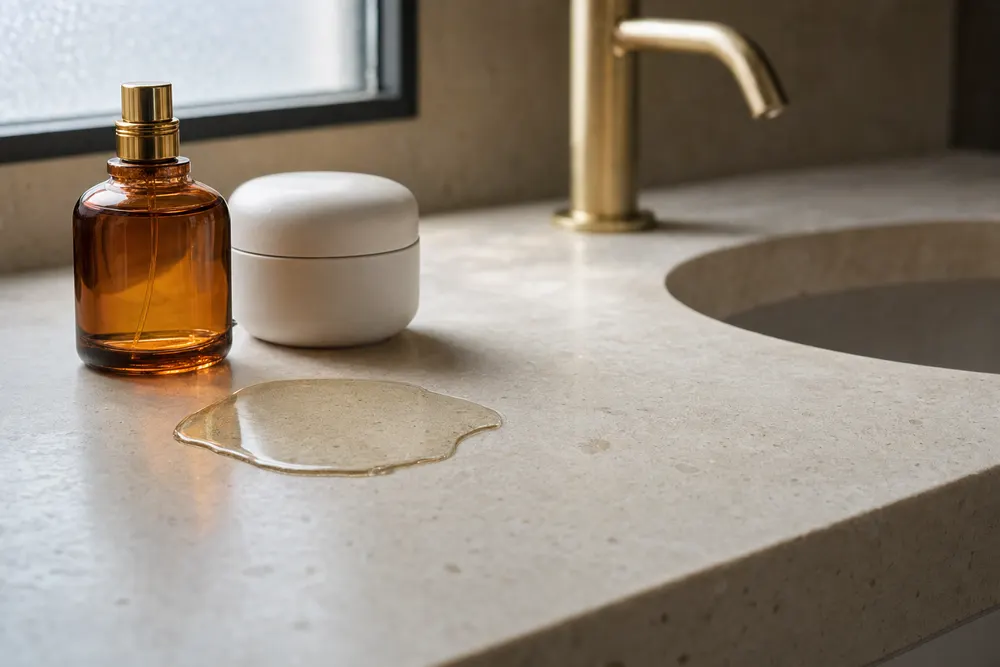
Limestone might be the most honest stone in the house: soft, warm, matte, and completely upfront about the fact that it marks easily. Protecting a limestone benchtop or vanity is about accepting what the stone is, then deciding how much of the work you want to do yourself.
Why limestone marks so easily
Limestone is calcium carbonate, the same chemistry as marble, so lemon juice, vinegar and soft drink etch dull patches into it on contact. It's more porous than marble, so oil, wine and coffee soak in faster and deeper. And it's softer, so dragged ceramics and metal leave scratches a polished granite would shrug off. In bathrooms the acids just wear different clothes: perfume, skincare and toothpaste all mark a limestone vanity the same way lemon marks a bench.
Daily care for limestone
Use pH-neutral soap and a microfibre cloth, nothing acidic and nothing abrasive: most supermarket bathroom cleaners are exactly what limestone can't tolerate. Blot spills immediately rather than wiping them around. Keep trays under bottles on vanities, boards and trivets in kitchens, and coasters wherever drinks land. Most limestone is honed, and living with honed stone covers that finish in detail.
Can sealing save limestone?
It helps with the soaking, not the reacting. A good penetrating sealer slows stains down, and on a stone this thirsty it needs renewing regularly. But the surface stays bare calcium carbonate, so the etch risk never moves. That's the pattern with every carbonate stone, and it's why sealers and film do different jobs.
Protection film on limestone
This is the stone where a physical barrier earns its keep fastest. An optically clear surface protection film in satin keeps the soft honed look while stopping the three things limestone can't stop itself: acid never touches the stone, spills sit on top instead of soaking in, and everyday scratches land on the film's self-healing surface. It works the same on the kitchen bench and the vanity, and it comes off without a trace if you ever want the bare stone back.
Soft stone, hard rules. Or one clear layer, and fewer rules.