
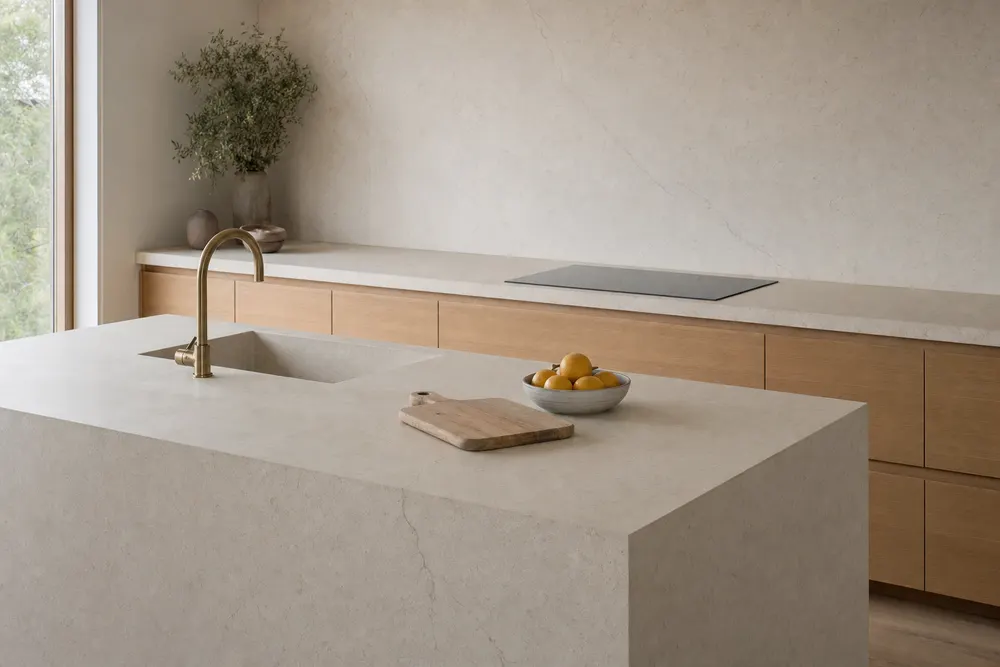
Nobody chooses honed stone by accident. You ran your hand across a polished slab, then a honed one, and the honed one won. The soft matte surface, the way it takes light without throwing it back, the fact it feels like stone rather than glass. Honed marble and limestone are the most touchable surfaces in any home.
They are also the thirstiest. This is a care guide for living with one, written honestly, including the part where we tell you that you might not need us.
Why honed behaves differently
Honing stops the polishing process early, on purpose. Instead of grinding the surface to a mirror, the stone is left with a fine, even texture that scatters light. That texture is the look. It is also, up close, a more open surface: more exposed pores, more places for liquid to sit and sink.
So honed stone drinks faster than polished. A splash of olive oil that would sit on polished marble long enough to be wiped away starts soaking into honed marble noticeably sooner. Coffee, curry and red wine behave the same way.
Etching plays a strange reverse trick too. On polished stone, acid burns a dull spot into the shine. On honed stone it does the opposite: it polishes a small shiny patch into the matte. Same chemistry, inverted evidence. If you have ever noticed glossy rings on a matte benchtop where the salad dressing was made, that is what happened. The chemistry is worth understanding, and we have explained it properly in why marble etches.
The upside is real. Honed surfaces are far more forgiving of fine scratches, which disappear into the texture instead of catching the light. Choosing honed was not a mistake. It just changes what care means.
The routine that actually works
- Use a pH-neutral stone cleaner, and nothing else. Supermarket sprays are often mildly acidic or alkaline, and both slowly work on calcium-based stone. Never vinegar. Never citrus-based cleaners, whatever the label says about natural cleaning. On marble or limestone, vinegar is not a cleaner. It is the damage.
- Blot spills, don't wipe. Wiping drags the liquid across more surface and pushes it into the texture. Press a cloth straight down, lift, repeat. Then clean the area properly.
- Deal with spills when they happen. On honed stone the difference between now and after dinner is the difference between a non-event and a mark.
- Boards and trivets, always. Not because the stone can't take a warm plate, but because habits are the cheapest protection ever invented. A cheap bottle of the right cleaner living on the bench beats an expensive one living in the cupboard.
- Watch the quiet offenders. Hand-soap dispensers, perfume bottles, oily condiment jars put straight down, a fruit bowl with lemons rolling loose. Most marks on honed stone come from things that live on the benchtop, not things spilled on it. Give the repeat offenders a tray.
When to reseal
A penetrating sealer is genuinely useful on honed stone, and it wears out invisibly. The test is simple: pour a tablespoon of water on the busiest part of the benchtop and wait ten minutes. If the stone darkens under the water, the sealer is done and it is time to reapply. On a honed marble benchtop that earns its keep, expect that roughly every year, sometimes sooner around the cooktop and sink.
Remember what resealing buys you: it slows staining. It does nothing for etching, which happens at the surface, above where the sealer lives.
And if a stain has already set, don't reach for bleach or a scourer. A poultice, a simple paste of absorbent powder and water left covered on the mark overnight, will draw many oil and tannin stains back out of the pores. Slow and unglamorous, and it works more often than you would expect.
Where film fits, honestly
Our satin film was made for this exact problem. It matches honed and matte finishes without adding shine, and while the film is intact it takes the staining question off the table: oil, wine and lemon juice land on a replaceable layer instead of the surface you chose, and the routine above shrinks to a wipe-down. The full picture, limits included, is on our how-it-works page.
"Not every honed benchtop needs film. Honed marble, in a kitchen that cooks, usually does."
But we would rather be accurate than persuasive. A careful household with a forgiving stone, a honed granite say, or a benchtop that works part-time, may do perfectly well with a good sealer and the habits above. Where film earns its place is honed marble and limestone in kitchens that actually cook, where every acidic splash is a coin-toss you are currently losing.
If you are not sure which side of that line you are on, send us a photo. We will tell you, even if the answer is a bottle of sealer.