
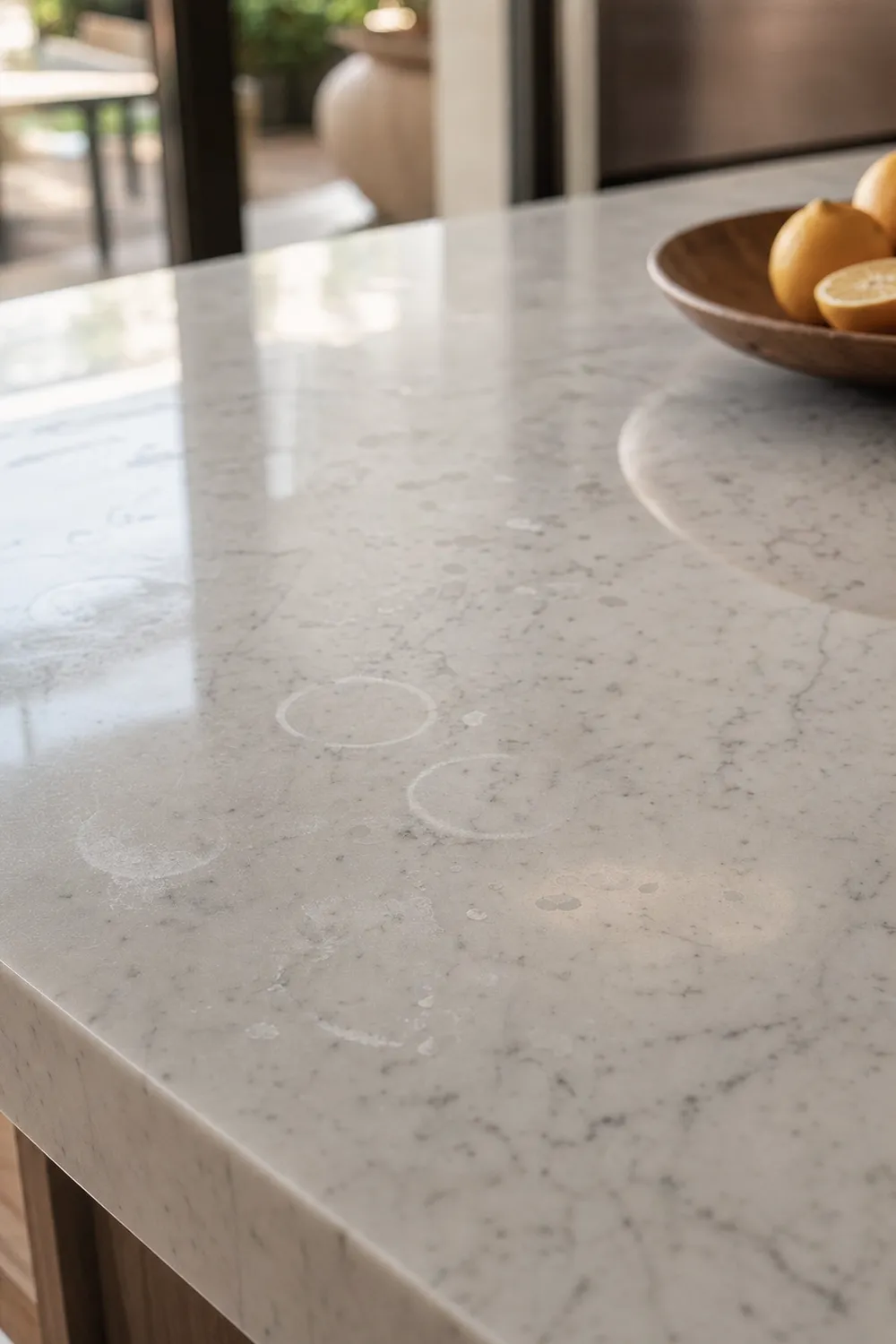
It happens in the first month. Someone halves a lemon, wipes the bench, and gets on with their evening. The next morning there is a dull ring on the marble that was not there before. It won't wipe off. It won't scrub off. Stone cleaner makes no difference, and neither does scrubbing harder.
Here is the uncomfortable truth: there is nothing left to clean. That mark is damage, and it had finished happening before anyone noticed it.
It isn't a stain. It's chemistry.
Marble is calcium carbonate. So are limestone and travertine, which is why all three behave the same way in a kitchen. And calcium carbonate has one defining habit: it reacts with acid. On contact. Every time.
So when lemon juice, vinegar, wine or soft drink lands on a marble benchtop, a small chemical reaction starts immediately. The acid dissolves a microscopic layer of the stone itself. If you have ever seen vinegar fizz on a stick of chalk, you have watched the same reaction, just faster. On your benchtop it happens quietly, under the glass, while dinner carries on around it.
The dull mark left behind is not something sitting on the stone. It is a patch where the polished surface of the stone is gone. That is why no cleaning product removes an etch mark. There is nothing to remove. The material has been dissolved, and cleaning cannot put stone back.
Why polished marble shows it worst
A polished finish is really just flatness. The slab is ground with finer and finer abrasives until the surface is so flat it reflects light like glass. That mirror depth is the thing people fall in love with in the showroom.
Etching destroys flatness. Where the acid sat, the surface becomes microscopically rough, and rough surfaces scatter light instead of reflecting it. Your eye reads that scatter as a dull, cloudy patch, usually in the exact shape of the glass, the slice or the splash that made it.
Honed marble scatters light everywhere by design, so etch marks hide better on it. They are still there. Stand at the window end of the kitchen late in the afternoon and raking light will find every one of them.
Why your sealer can't stop it
Almost every stone benchtop in Perth was sealed the week it was installed, and most owners assume that settles the matter. It doesn't. To see why, it helps to know what a sealer actually is.
Modern stone sealers are impregnators. They soak down into the pores of the stone and line them, so that liquids bead on the surface instead of soaking straight in. Against staining, that is genuinely useful. Oil and coffee absorb slowly instead of instantly, which buys you time to catch the spill.
But etching is not absorption. It is a surface reaction, and it begins the instant acid touches stone. The sealer is sitting in the pores below the surface. The face of the benchtop, the part your lemon actually touches, is still bare calcium carbonate. Which is why a sealed marble top etches just as readily as an unsealed one.
A sealer changes how fast your stone absorbs. It can't change what your stone is made of.
None of this makes sealers a con. They do a real job against staining, and stone that isn't filmed should stay on a sensible sealing routine. It is simply a different job from the one most people believe they paid for. If someone tells you a sealer will stop etching, they are wrong about their own product.
What actually works: separation
If the problem is acid meeting stone, the only real fix is to make sure acid never meets stone. Not a treatment soaked into the surface. A physical barrier sitting above it.
That is what a protection film is: an optically clear layer fitted over the finished surface and trimmed by hand at the edges. The lemon juice lands on film. The wine ring forms on film, and wipes away. While the film is intact, the reaction that ruins marble never starts: the acid and the stone never touch.
The film takes the scratches too, and its self-healing top layer tightens fine marks back out with a little warmth. When the film eventually comes off, the adhesive is engineered to release cleanly, so the polish underneath is exactly as it was the day it was covered.
We are careful not to oversell it. A determined knife will still mark the film, and hot pans still get a trivet, at our place as well as yours. We publish those limits on our how-it-works page, because you should read them before you pay for anything.
Do you need film? Maybe not.
Honesty cuts both ways, so here is the other half.
Granite is a different rock. It is mostly silicate minerals, which do not react with everyday kitchen acids the way calcium carbonate does. Plenty of granite owners go a decade without a single etch mark, and if that is you, a good sealing routine may honestly be all your benchtop needs. We will tell you that to your face.
Porcelain and sintered surfaces generally do not need film at all, and we say so.
Marble, limestone, travertine and onyx are a different conversation. In a working kitchen, etching on those stones is a when, not an if. If that is the surface you chose and love, a physical barrier is the approach that answers the actual chemistry.
Still weighing it up? Read our honest comparison of sealers, coatings and film, or go straight to how to protect marble benchtops. Or skip ahead and ask us directly. The answer costs nothing either way.